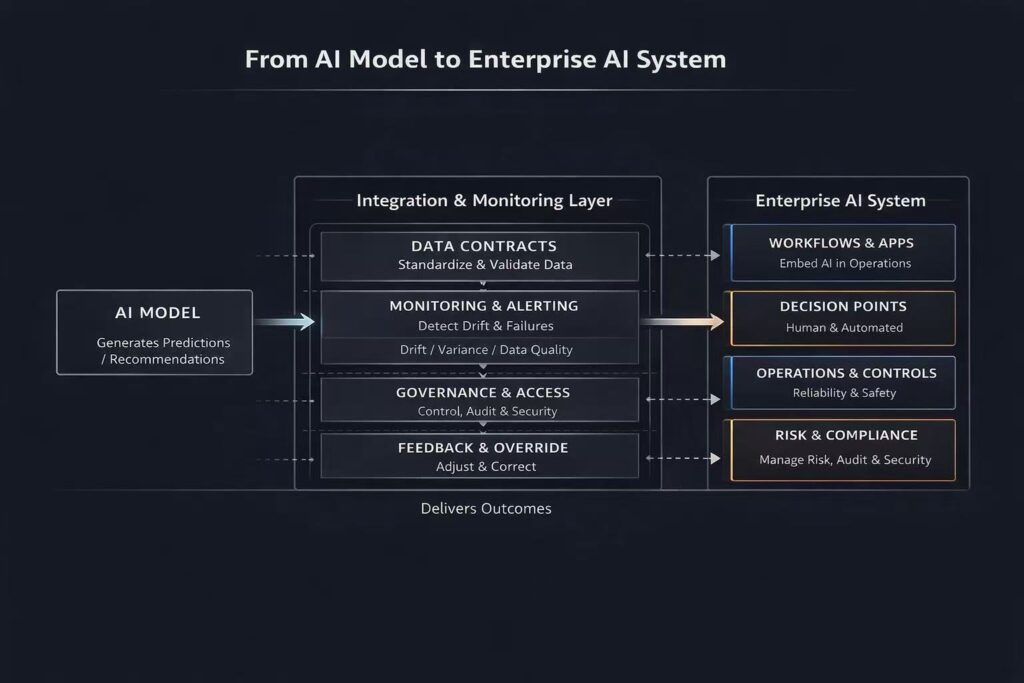
From AI Models to enterprise AI systems: what most organization get wrong?
Summary
Enterprise AI does not fail because models are weak — it fails because systems are missing.
The real challenge is turning AI into an operational capability that survives enterprise and factory-floor reality.
Introduction
Enterprises today have unprecedented access to powerful AI models.
Yet most AI initiatives still stall after demos, pilots, or isolated proofs of concept.
The problem is rarely model quality.
The real gap is the difference between an AI model and an enterprise AI system — and organizations often recognize it only after time, budget, and confidence have already been consumed.
This article clarifies the distinction and explains why system-level thinking is now the decisive factor for enterprise AI success — especially in real production environments.
1) AI Models Answer Questions. AI Systems Must Survive Reality.
An AI model can generate outputs.
An enterprise AI system must operate inside environments shaped by:
• fragmented data sources and inconsistent definitions
• multi-team ownership and layered decision rights
• security, access control, and audit expectations
• reliability, uptime, and operational constraints
• failure costs that are reputational, financial, and strategic
A model can be impressive while the system remains unusable.
Enterprise outcomes depend far less on model intelligence than on whether the surrounding system is coherent, resilient, and accountable.
2) Why Most Enterprise AI Pilots Fail
Most pilots are designed to prove that “AI can work.”
They are not designed to prove that “AI can operate.”
Common failure patterns include:
Data pipelines that work once, but not continuously
Pilots often rely on curated datasets.
Reality is noisy, incomplete, and constantly changing.
Outputs that cannot be trusted, audited, or governed
Without governance, users default to skepticism or over-reliance—both are fatal.
No clear ownership for decisions influenced by AI
Adoption stalls when accountability is unclear.
People do not integrate what they cannot own.
Integration postponed until the end
The AI “works,” but cannot be embedded into workflows without breaking existing systems.
These are not failures of AI capability.
They are failures of system design and organizational readiness.
3) The Enterprise Overestimates Intelligence and Underestimates Integration
Many organizations assume stronger models will eventually solve adoption.
In practice, enterprise success depends more on questions like:
• Where does AI sit in the workflow?
• What happens when the AI is wrong or uncertain?
• Who can override it, and when?
• How do we detect drift, degradation, or silent failure?
• How do we measure impact without gaming metrics?
Integration maturity matters more than model sophistication.
Enterprises do not need AI that is merely accurate.
They need AI that is operational.
4) Why AI Is Still Limited on the Factory Floor
AI adoption in office workflows is accelerating.
But in real production environments, AI remains far more constrained.
The reason is structural: factory-floor reality is high-variance and non-standardized.
Production data is typically:
• multi-source (PLC/SCADA/MES/sensors/manual logs/QA)
• multi-rate (milliseconds to weekly batches)
• inconsistent across lines, plants, and process conditions
• shaped by operators, maintenance habits, and equipment drift
This complexity cannot be solved by “adding an LLM on top.”
LLMs are powerful for language tasks, but they do not automatically solve the core problems of manufacturing AI:
• industrial semantics (what the signals truly mean)
• operational causality (what actually caused the deviation)
• cross-line generalization (why the same solution fails in a different line)
In B2B production, generalization is the exception — not the default.
5) Production Is Not an Upgrade — It Is a Transformation
Production is not a higher-performance prototype.
It requires systems to handle:
• scale and real-time constraints
• edge cases and exceptions
• changing upstream inputs
• monitoring, alerting, fallbacks, and rollbacks
• maintainability as change becomes the default state
The organization must move from:
“Can it work?” → “Can we run it indefinitely?”
6) What Building Enterprise AI Systems Actually Requires
Enterprise AI systems are built, not installed.
They require:
• system architecture aligned to enterprise constraints
• ownership models that define accountability
• data governance that prevents silent inconsistencies
• monitoring that detects failure before users do
• maintenance models designed for drift and change
Most importantly, they require a mindset shift:
AI is not a feature. AI is an operational capability.
And capabilities must be designed to survive the long term.
Conclusion
The future of enterprise AI will not be determined by who has access to the most powerful models.
It will be determined by who can convert AI into systems that organizations can operate, trust, and evolve — including in the most difficult environment: real production.
Understanding the difference between AI models and enterprise AI systems is the first step.